
Data Science Explained: Turning Raw Data Into Insights
In today’s digital economy, data is being generated at an unprecedented scale, from websites, mobile apps, sensors, transactions, and connected devices. However, raw data on its own has little value. The real power lies in the ability to analyze, interpret, and transform that data into meaningful insight. This is exactly what data science enables, making data science explained an essential topic for anyone looking to understand modern technology.
Data science combines statistics, computing, and domain knowledge to extract insights that support smarter decisions. Organizations rely on data science to understand behavior, predict trends, and optimize operations Data Science Explained. Whether it’s improving customer experiences or driving strategic planning, data science plays a central role in how technology creates value today. This article explains data science in simple, structured terms. You’ll learn how data analysis, data modeling, and data visualization work together within the data science process, and how modern analytics tools help convert raw data into actionable intelligence.
What Is Data Science?
Data science is a multidisciplinary field focused on extracting insights from data. It uses mathematical methods, computational techniques, and analytical thinking to uncover patterns, trends, and relationships hidden within large datasets Data Science Explained. At its core, data science answers questions such as:
- What happened?
- Why did it happen?
- What is likely to happen next?
Unlike traditional reporting, data science goes beyond static summaries. It explores data dynamically, tests hypotheses, and builds models that help predict outcomes. This ability to move from observation to prediction is what makes data science explained so valuable across industries. Data science integrates multiple components, including data analysis, data engineering, statistics, and machine learning. Together, these elements transform data into insights that support decision-making at scale.
Data Science Process:
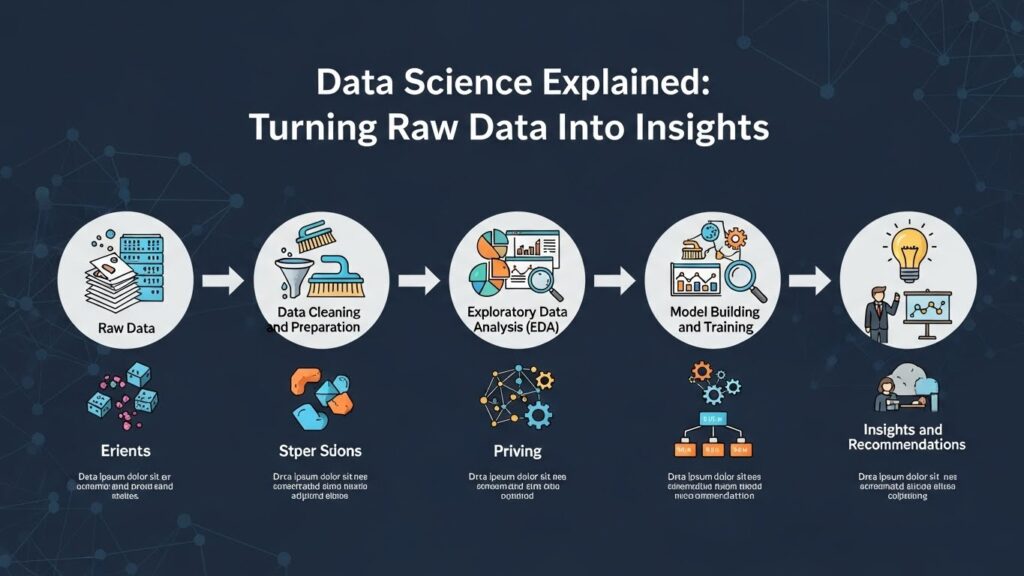
The data science process follows a structured workflow that ensures insights are accurate, reliable, and useful. While implementations vary, most data science projects follow similar stages. The process begins with problem definition. Data scientists identify what question needs to be answered and what success looks like. Clear objectives prevent wasted effort and guide the entire analysis.
Next comes data collection and preparation. Data is gathered from various sources and cleaned to remove errors, duplicates or Data Science Explained, and inconsistencies. This step is critical; poor data quality directly affects outcomes. Once prepared, the data moves into analysis and modeling, where patterns are explored and relationships tested. After insights are generated, results are communicated through data visualization and reports, making them accessible to decision-makers. Finally, insights are validated and refined over time as new data becomes available. This iterative nature ensures data science remains relevant and adaptive.
Data Analysis:
Data analysis is one of the foundational pillars of data science. It focuses on examining datasets to understand what the data reveals about a given problem or situation. Data analysis includes descriptive techniques that summarize information, as well as diagnostic approaches that explain why certain outcomes occurred. Analysts explore trends, distributions, correlations, and anomalies to gain a clear picture of the data.
This stage often answers “what” and “why” questions. For example, why did sales decline in a specific region, or what factors influence user engagement? By answering these questions, data analysis sets the stage for deeper insights and predictive modeling. Without effective data analysis, advanced techniques like modeling and machine learning lack context. This is why data analysis remains central to data science explained.
Data Modeling:
Data modeling takes analysis a step further by creating mathematical or statistical representations of real-world processes. These models help explain relationships within data and predict future outcomes.
Models can range from simple statistical formulas to complex algorithms. They allow data scientists to simulate scenarios, test assumptions, and estimate the impact of changes. For example, a model might predict customer churn or forecast demand based on historical behavior. Data modeling is essential for moving from insight to action. It enables organizations to plan rather than react after the fact. Within the data science process, modeling is where data becomes a strategic asset.
Data Visualization:
Even the most accurate analysis has limited value if decision-makers can’t understand it. Data visualization bridges this gap by translating complex data into clear, visual formats such as charts, graphs, and dashboards.
Visualization helps highlight trends, comparisons, and outliers at a glance. It enables faster comprehension and supports better communication between technical and non-technical stakeholders. In modern data science, visualization is not an afterthought; it’s an integral part of analysis. Effective visualization ensures insights lead to action, reinforcing the purpose of data science explained.
Analytics Tools Used in Data Science
Modern data science relies heavily on powerful analytics tools that support data processing, analysis, modeling, and visualization. These tools allow teams to handle large datasets efficiently and collaborate effectively.
Analytics tools automate repetitive tasks, enable scalable computation, and provide interactive environments for exploration. They also integrate with databases, cloud platforms, and reporting systems, making insights accessible across organizations. The choice of tools depends on project complexity, data size, and business needs. However, tools alone do not create insight; success depends on applying the right methods within the data science process.
Real-World Applications of Data Science
Data science is applied across a wide range of industries. In business, it supports customer segmentation, pricing optimization, and demand forecasting. In healthcare, it improves diagnosis, treatment planning, and resource allocation.
Finance uses data science for fraud detection, risk assessment, and algorithmic trading. Technology platforms rely on it for personalization, recommendation systems, and performance optimization. These applications demonstrate how turning raw data into insight creates tangible value, reinforcing why data science explained is a critical topic in modern technology.
Challenges and Limitations in Data Science
Despite its power, data science faces challenges. Data quality issues, bias, privacy concerns, and model interpretability all require careful management. Poor assumptions or incomplete data can lead to misleading conclusions.
Scalability is another concern. As data volumes grow, systems must handle increased complexity without sacrificing accuracy or performance. Addressing these challenges requires technical expertise, ethical awareness, and ongoing monitoring. Understanding these limitations is essential to using Data Science Explained responsibly and effectively.
The Future of Data Science
The future of data science lies in automation, real-time analytics, and deeper integration with intelligent systems. Tools are becoming more user-friendly, allowing non-specialists to engage with data-driven insights.
As data continues to expand, data science will play an even greater role in shaping decisions, products, and strategies. Its evolution ensures that organizations can keep pace with complexity while unlocking new opportunities.
Conclusion:
Understanding data science explained goes far beyond learning how to analyze numbers; it reveals how modern organizations think, plan, and compete in a data-driven world. Every digital interaction generates information, but without data science, that information remains unused potential. Data science is the discipline that turns complexity into clarity and uncertainty into informed action.
By combining data analysis, Data Science Explained modeling, and data visualization, data science creates a complete framework for understanding both the present and the future. The structured data science process ensures insights are not based on guesswork, but on validated evidence and repeatable methods. This reliability is why data science plays a central role in strategic decision-making across industries. Advanced analytics tools have made data science more scalable and accessible, but tools alone are not enough. The true value of data science lies in asking the right questions, interpreting results responsibly, and applying insights in context. As data volumes grow and systems become more complex, these human elements become even more important.
FAQs:
What is data science in simple terms?
Data science is the practice of analyzing data to discover insights, patterns, and predictions.
How is data science different from data analysis?
Data analysis focuses on understanding existing data, while data science includes modeling, prediction, and advanced techniques.
Why is data visualization important in data science?
Visualization helps communicate insights clearly and supports faster decision-making.
What tools are used in data science?
Data science uses analytics tools for data processing, modeling, and visualization.
Is data science in demand?
Yes. Data science remains one of the most in-demand fields across industries.


