
Student Loan Repayment Calculator UK: How It Works Explained
Student loans are one of the biggest financial commitments many people face after higher education in the UK. With rising tuition fees and living costs, graduates often leave university with debts running into tens of thousands of pounds. Unlike traditional loans, however, UK student loans work differently; they are linked to your income, not just the borrowed amount. This makes Student Loan Repayment Calculator UK repayment less straightforward to calculate, leaving many borrowers unsure about how much they will actually pay back each month.
This is where a Student Loan Repayment Calculator becomes invaluable. Instead of guessing or worrying about repayments, you can use this simple tool to estimate how much you’ll pay based on your income, the repayment plan you’re on, and the interest applied to your loan. Whether you’re a recent graduate planning your first job or someone earning more and wondering how quickly you’ll clear your balance, these calculators help bring clarity to what can otherwise feel like a confusing process. In this guide, we’ll explain how student loan repayment works in the UK, break down what a calculator does, and show you the benefits and limitations of relying on one. By the end, you’ll understand not just how much you might repay, but also how this tool can help you manage your finances more confidently.
Understanding Student Loans in the UK
Student Loan Repayment Calculator UK are very different from traditional personal loans or credit cards. Instead of being repaid through fixed monthly instalments, repayments are based on your income once you start earning above a certain threshold. This means that if your income is below the repayment threshold, you don’t pay anything at all, and if your salary increases, so do your repayments. There are several repayment plans depending on when and where you studied. Plan 1 usually applies to students who started their course before September 2012 in England and Wales, or at any time in Northern Ireland. Plan 2 is for those who began studying in England or Wales after September 2012, while Plan 4 covers Scottish students. In addition, there is a Postgraduate Loan plan for those pursuing master’s or doctoral degrees. Each plan has its own repayment threshold and interest rate, which can significantly affect how much you pay over time.
Another important feature of UK student loans is that any outstanding balance does not stay with you forever. Loans are written off after a certain number of years, usually 25 to 40 years, depending on your plan, or earlier if you reach the repayment cap. This structure makes student loans less burdensome than traditional debts, but it also makes it more complex to estimate what you will eventually pay. Because of these variables, many graduates find it difficult to predict their future repayments. This is exactly where a Student Loan Repayment Calculator becomes a practical tool, as it takes into account the different plans, thresholds, and income levels to give a clearer picture of repayment expectations.
What Is a Student Loan Repayment Calculator?
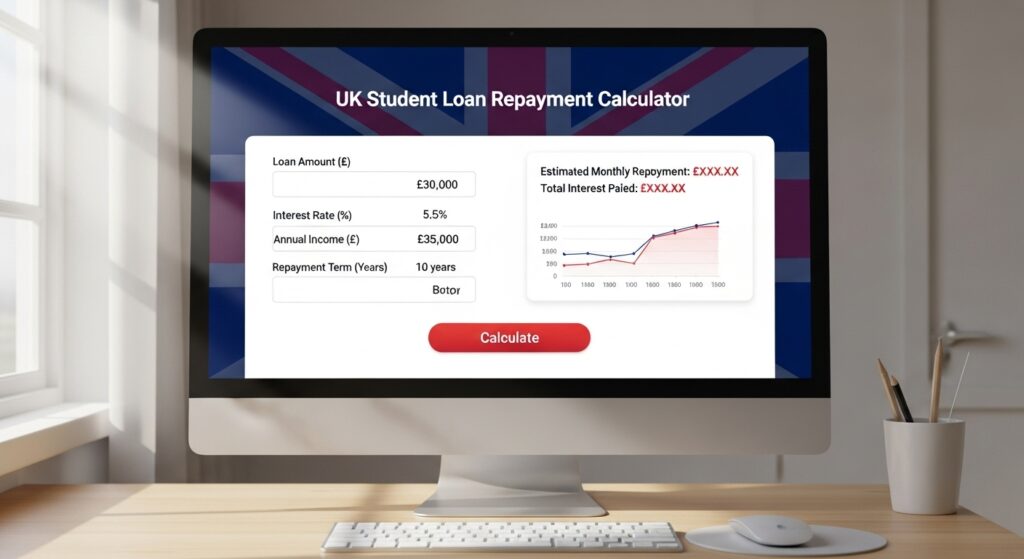
A Student Loan Repayment Calculator UK is an online tool designed to help borrowers estimate how much they will need to repay on their student loans each month and over time. Instead of manually working out complex formulas involving income thresholds, repayment percentages, and interest rates, the calculator simplifies the process by generating quick, tailored results. In the UK, student loans are not repaid like traditional debts. Since repayments are tied to your earnings and vary depending on your loan plan, it can be difficult to predict your financial commitment. A calculator solves this problem by asking for a few key details, such as your annual income, the type of repayment plan you are on, and whether you have a postgraduate loan, and then estimating your monthly payments and overall repayment outlook.
The main purpose of a student loan repayment calculator is not only to show how much you might pay but also to give you a clearer sense of how changes in your salary or repayment plan can affect your loan. For example, if you are about to switch jobs, you can use the calculator to see how your repayments would change with a higher or lower salary. This makes it an essential tool for graduates who want to plan their finances more effectively and avoid surprises when they receive their payslip.
How Student Loan Repayment Calculators Work?
A Student Loan Repayment Calculator works by combining the repayment rules set by the Student Loan Repayment Calculator UK with the personal details you enter, giving you a tailored estimate of what your repayments might look like. To begin with, you input your annual income, since repayments are directly linked to how much you earn above the repayment threshold for your loan plan. The calculator also asks you to specify which repayment plan you fall under: Plan 1, Plan 2, Plan 4, or the Postgraduate Loan, because each has its own threshold and repayment rate. Once these details are entered, the calculator applies the correct repayment percentage to your income above the threshold. For example, under Plan 2, graduates pay 9% of anything they earn above the current threshold, while postgraduate loans require 6% of income above their separate threshold. The calculator also factors in interest rates, which are based on the Retail Price Index (RPI) and sometimes adjusted according to income. By combining these variables, the calculator shows your estimated monthly repayment and, in some cases, projects how long it might take you to repay the loan entirely.
To illustrate, imagine a graduate earning £30,000 a year on Plan 2. The repayment threshold is £27,295, meaning they pay 9% on the £2,705 above that threshold, which comes to about £20 per month. Someone earning £50,000 a year, however, would repay much more because they earn £22,705 above the threshold, leading to repayments of roughly £170 per month. By running these examples, the calculator helps borrowers clearly see the impact of income changes on their loan obligations. In short, student loan repayment calculators take away the guesswork. They transform a complicated repayment system into straightforward, easy-to-understand figures, helping graduates budget with confidence and plan for the future.
Conclusion
Managing student loans can feel overwhelming, especially when repayment rules vary by plan and depend heavily on income. This is why a Student Loan Repayment Calculator is such a valuable tool for Student Loan Repayment Calculator UK graduates. It takes a complex repayment system and translates it into clear, practical numbers, showing you exactly how much you might pay each month and how changes in your salary could affect your obligations.
While calculators can’t predict the future with complete accuracy, since factors like government policy, inflation, and salary progression can all change, they provide an essential starting point for financial planning. By using one, you gain a clearer picture of your student loan commitments, which helps reduce uncertainty and empowers you to make smarter money decisions. Ultimately, understanding your student loan repayments is about more than just paying off debt; it’s about taking control of your financial future. A calculator won’t eliminate your loan, but it will give you the insight you need to manage it with confidence.
FAQs
How accurate is a Student Loan Repayment Calculator?
A Student Loan Repayment Calculator provides reliable estimates based on your income, loan plan, and repayment thresholds. However, it cannot account for future changes in interest rates, government policies, or unexpected changes in your salary, so the figures should be seen as a guide rather than a guarantee.
Do calculators include interest automatically?
Yes, most calculators factor in the interest rates linked to your specific loan plan. Since UK student loan interest is tied to the Retail Price Index (RPI) and may vary with income, the calculator uses current rates to provide as accurate an estimate as possible.
Can a calculator tell me when my loan will be written off?
Calculators can estimate repayment timelines, but the actual write-off depends on your loan plan. For example, Plan 2 loans are written off 30 years after repayment begins, while Plan 4 loans are cleared after 30 years too. The calculator may give you an idea, but the outcome depends on your career earnings and repayment history.
Are student loans in the UK the same as in the US?
No. UK student loans work differently from US loans. In the UK, repayments are income-based, meaning you only pay if you earn above the repayment threshold. In the US, loans typically require fixed repayments regardless of income.