
Minimum Payment Calculator vs Full Repayment Calculator: Spot the Difference
Managing credit card debt effectively requires more than just making payments on time—it requires planning. Many cardholders rely on minimum payments, unaware of how long it will take to pay off their balances or how much interest they will accumulate. Financial tools, such as calculators, make it easier to visualize repayment timelines and understand the true cost of debt. Two commonly used tools are the Credit Card Minimum Payment Calculator and the full repayment calculator.
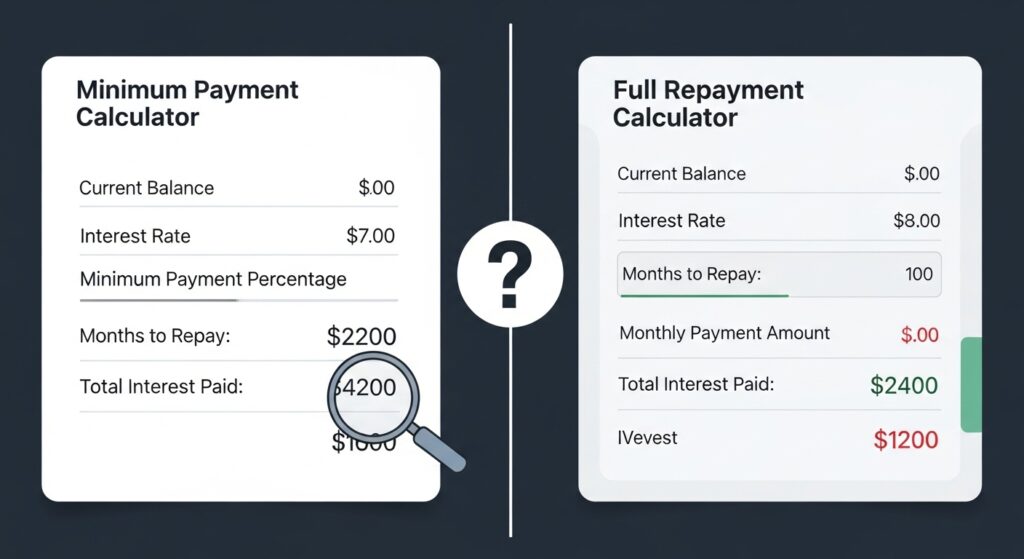
The Payment Calculator vs Full Repayment shows how long it would take to clear your debt if you only make the smallest monthly payments, highlighting the hidden costs and interest accumulation. On the other hand, a full repayment calculator helps plan more aggressive strategies to pay off debt faster while minimizing interest. In this guide, we’ll compare the two calculators, explore their differences, and explain how using them together can help you make informed decisions. By understanding each tool’s purpose, you can choose the approach that best aligns with your financial goals and take control of your credit card debt before it spirals out of hand.
Understanding Credit Card Minimum and Full Repayment Calculators
Managing credit card debt effectively requires understanding how different repayment strategies impact your timeline and interest costs. Two essential tools can help: the Credit Minimum Payment Calculator and the full repayment calculator. A Credit Card Minimum Payment Calculator shows the consequences of paying only the minimum each month. By entering your balance, interest rate, and monthly payment, the tool estimates how long it will take to clear your debt and the total interest you’ll pay. It highlights how minimum payments barely reduce the principal, extending repayment over many years and increasing long-term costs. You can try it directly via the Credit Card Minimum Payment Calculator to see the hidden costs for yourself.
On the other hand, a full repayment calculator helps plan more aggressive strategies to pay off debt faster. It calculates the total payments and interest when you aim to clear your balances within a chosen timeframe. While it requires higher monthly payments, it reduces interest significantly and shortens the repayment period. Together, these tools provide a clear picture of your options, allowing you to choose a strategy that balances affordability, efficiency, and financial goals.
Key Differences Between the Two Calculators
While both calculators help you understand credit card repayment, they serve different purposes and produce distinct results. Comparing them side by side makes it easier to choose the right tool for your financial goals.
Feature | Credit Card Minimum Payment Calculator | Full Repayment Calculator |
Focus | Shows the impact of minimum payments | Calculates payoff with higher payments |
Repayment Timeline | Often much longer | Shorter, based on planned repayment |
Interest Paid | Typically higher due to prolonged balance | Lower total interest |
Motivation Factor | Reveals hidden risks of minimum payments | Encourages faster payoff |
Complexity | Simple, requires balance and interest | Slightly more complex, includes a payment schedule |
Best For | Understanding the risks of minimum payments | Planning aggressive debt repayment |
Using a Credit Card Payment Calculator highlights the cost of making only the minimum payments and emphasizes why paying extra is beneficial. Meanwhile, a full repayment calculator is ideal for those who want to pay off debt efficiently and minimize interest. Understanding these differences allows you to make informed decisions and choose the strategy that aligns with your financial goals.
Which Calculator Should You Use?
Choosing the right tool depends on your financial goals, repayment habits, and personal motivation. If your goal is to understand the risk of making only minimum Payment Calculator vs Full Repayment and see how long it will take to pay off debt, a Credit Card Minimum Payment Calculator is ideal. It reveals the hidden costs of prolonged debt, making it easier to plan for smarter repayment strategies. This calculator is especially helpful for cardholders who want to track progress or test how small increases in monthly payments can impact their repayment timeline.
On the other hand, a full repayment calculator is designed for those who aim to pay off debt efficiently and minimize interest. It helps you create a structured plan to clear balances in a defined timeframe, showing exactly how much to pay each month to reach that goal. For many users, the best approach is to use both calculators in tandem: start with the minimum payment calculator to understand current risks, then switch to a full repayment calculator to plan a faster, more cost-effective repayment strategy. This combination ensures you stay informed, motivated, and financially efficient.
Combining Insights for Smarter Debt Management
Using both a Credit Card Payment Calculator and a full repayment calculator together can give you a comprehensive view of your debt situation. The minimum payment calculator highlights the long-term costs and risks of sticking to small payments, while the full repayment calculator helps you plan an aggressive strategy to pay off balances faster and reduce interest.
A practical approach is to first input your balances into the Minimum Payment Calculator to see how long it would take to become debt-free if you made only minimum payments. Then, use a full repayment calculator to test different monthly payment amounts, identifying a realistic plan that shortens your repayment timeline and saves money.
Additionally, financial resources such as Loan and Debt tools and broader planning guidance available on Fincalc.uk can help you track progress, adjust your strategy, and stay motivated. By combining insights from both calculators, you can make smarter decisions, pay off debt more efficiently, and achieve financial freedom sooner.
Conclusion
Both the Credit Card Minimum Payment Calculator vs Full Repayment and the full repayment calculator are valuable tools, but they serve different purposes. The minimum payment calculator highlights the hidden costs and long-term risks of making only the smallest payments, while the full repayment calculator helps plan a faster, more efficient path to becoming debt-free. Using both calculators together allows you to understand your current financial situation, explore repayment scenarios, and choose the strategy that aligns with your goals.
By paying more than the minimum and tracking your progress with these tools, you can reduce interest, shorten repayment timelines, and take control of your credit card debt. Strategic use of calculators, combined with smart financial habits, empowers you to make informed decisions, stay motivated, and achieve long-term financial stability. Start leveraging these tools today to manage your credit card debt effectively and move confidently toward a debt-free future.
FAQs
What is the main purpose of a Credit Card Minimum Payment Calculator?
It shows how long it will take to pay off your debt if you make only the minimum payments and highlights the total interest cost.
How does a full repayment calculator differ from a minimum payment calculator?
A full repayment calculator helps plan an aggressive payoff strategy, showing exact monthly payments and interest savings, while the minimum payment calculator focuses on the risks of minimal payments.
Which calculator helps save more money in the long run?
The full repayment calculator saves more interest because it plans higher monthly payments and shortens the repayment period.
Can I use both calculators together?
Yes. Start with the minimum payment calculator to understand risks, then use a full repayment calculator to plan a faster, cost-efficient repayment strategy.
Where can I find these tools?
You can access the Credit Card Minimum Payment Calculator, as well as other planning resources on Loan and Debt tools and Fincalc.uk.