
DevOps Explained: Bridging Development and Operations
Modern software is expected to be fast, reliable, and continuously improving. Users demand frequent updates, minimal downtime, and seamless performance across platforms. Meeting these expectations is difficult when development and operations teams work in isolation. This challenge led to the rise of DevOps, a practice designed to unite teams, tools, and processes. Understanding DevOps explained is essential for grasping how modern software delivery works today.
DevOps is not a tool or a single technology; it is a cultural and technical approach that bridges the gap between software development and IT operations. By aligning goals and workflows, DevOps enables faster releases, higher quality, and more stable systems. Organizations adopting DevOps improve software delivery while reducing errors and operational friction. This article explains DevOps in simple, practical terms. You’ll learn what DevOps is, how the DevOps lifecycle works, the role of the CI CD pipeline, the importance of DevOps tools, and how automation workflows transform software development.
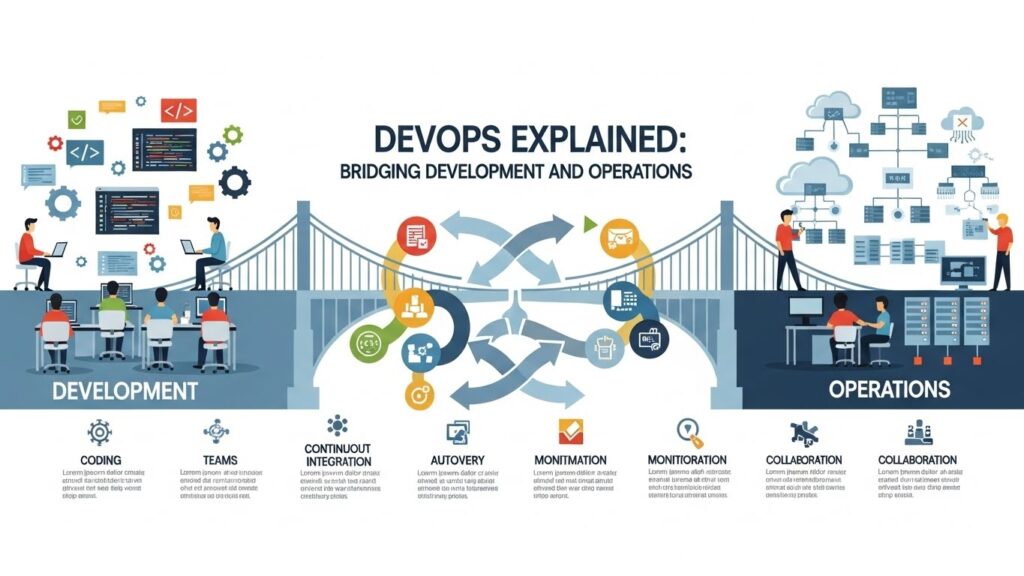
What Is DevOps?
DevOps is a set of practices that combines software development (Dev) and IT operations (Ops) into a unified process. Its primary goal is to shorten the development cycle while delivering high-quality software continuously.
Traditionally, development teams focused on building features, while operations teams focused on stability and uptime. This separation often caused delays, miscommunication, and deployment failures. DevOps removes these barriers by encouraging collaboration, shared responsibility, and automation. When DevOps explained clearly, it becomes evident that it is both a mindset and a methodology. It emphasizes transparency, rapid feedback, and continuous improvement across the entire software lifecycle.
Why DevOps Matters in Modern Software Development?
The speed of digital innovation has made traditional development models too slow and rigid. Businesses need to respond quickly to market changes, security threats, and user feedback. DevOps enables this agility.
By integrating development and operations, teams can release updates more frequently and with greater confidence. Automated testing and deployment reduce human error, while monitoring systems provide real-time insights into application performance. DevOps directly improves software delivery by making releases predictable, repeatable, and scalable. This reliability is why DevOps has become a standard practice in modern technology organizations.
The DevOps Lifecycle:
The DevOps lifecycle represents the continuous process through which software is planned, built, tested, deployed, and monitored. Unlike linear development models, the DevOps lifecycle is circular and iterative.
It begins with planning, where teams define requirements and priorities. Next comes development, where code is written and reviewed collaboratively. The code then moves into testing, often automated, to ensure quality and stability. Once tested, software is deployed into production environments using automated pipelines. After deployment, systems are monitored continuously to detect issues and gather performance data. Feedback from monitoring informs future improvements, completing the cycle. This continuous loop ensures that software evolves rapidly while maintaining reliability.
CI CD Pipeline:
A key component of DevOps is the CI CD pipeline, which stands for Continuous Integration and Continuous Delivery (or Deployment). This pipeline automates the process of integrating code changes, testing them, and delivering them to production.
Continuous Integration ensures that new code is merged frequently and tested automatically. This practice catches issues early and prevents integration problems. Continuous Delivery automates the release process, ensuring software is always in a deployable state. The CI CD pipeline reduces manual effort, speeds up releases, and improves consistency. It is one of the most powerful enablers of modern automation workflows in DevOps.
DevOps Tools:
DevOps tools support collaboration, automation, and visibility across teams. These tools cover areas such as version control, testing, deployment, configuration management, and monitoring.
Version control systems allow multiple developers to work on the same codebase safely. Testing tools automate quality checks, while deployment tools ensure consistent releases across environments. Monitoring tools provide insights into system health and user experience. The effectiveness of DevOps depends not on any single tool, but on how tools are integrated into a cohesive workflow. When aligned correctly, DevOps tools enable seamless software delivery at scale.
Automation Workflows:
Automation is at the heart of DevOps. Automation workflows replace manual, repetitive tasks with scripted processes that run consistently every time.
Automated builds, tests, deployments, and infrastructure provisioning reduce human error and free teams to focus on innovation. Automation also improves traceability and compliance by creating repeatable, documented processes. In DevOps explained, automation is not about removing people; it’s about empowering teams to work faster and more confidently. This shift is a defining feature of DevOps success.
DevOps Culture:
While tools and automation are important, DevOps is ultimately about culture. Teams must adopt shared ownership, open communication, and continuous learning. A strong DevOps culture encourages collaboration between developers, operations engineers, and other stakeholders. Failures are treated as learning opportunities rather than blame points. Feedback loops ensure rapid improvement.
Understanding DevOps explained without recognizing its cultural dimension, leads to incomplete adoption. Successful DevOps transformations balance people, processes, and technology.
Benefits:
Organizations that adopt DevOps experience tangible benefits. These include faster release cycles, improved system stability, reduced downtime, and better customer satisfaction.
DevOps also improves scalability and resilience. Automated systems can adapt to increased demand, while monitoring ensures a quick response to issues. These advantages make DevOps a strategic asset rather than just a technical practice.
Challenges and Limitations of DevOps
Despite its benefits, DevOps adoption comes with challenges. Cultural resistance, skill gaps, and legacy systems can slow progress. Over-automation without proper governance can also introduce risks.
Successful DevOps requires leadership support, clear goals, and incremental implementation. Understanding these challenges helps organizations approach DevOps realistically and sustainably.
The Future of DevOps
DevOps continues to evolve alongside cloud computing, automation, and intelligent systems. Future trends include deeper automation, smarter monitoring, and tighter integration with security practices.
As software becomes more complex and distributed, DevOps will remain essential for managing change and maintaining reliability. Its principles will continue to shape how software is built and delivered.
Conclusion:
Understanding DevOps explained provides insight into how modern organizations build, release, and maintain software at speed and scale. In an environment where users expect constant improvement and uninterrupted service, traditional handoffs between development and operations are no longer sufficient. DevOps addresses this gap by aligning teams, automating processes, and embedding reliability into every stage of software creation. What makes DevOps truly transformative is its focus on continuous flow. The DevOps lifecycle replaces rigid, linear development with an iterative model that supports rapid feedback and constant refinement. Through automated CI CD pipelines and well-integrated DevOps tools, teams can release updates frequently while maintaining stability and quality. This balance between speed and control is critical for sustainable software delivery.
Equally important is the cultural shift that DevOps explained. Automation workflows reduce manual effort, but collaboration, shared ownership, and transparency drive long-term success. Organizations that embrace DevOps as both a technical and cultural practice are better equipped to adapt to change, manage complexity, and innovate with confidence. Looking ahead, DevOps will continue to evolve alongside cloud computing, security practices, and intelligent automation. However, its core principles, collaboration, automation, and continuous improvement, will remain constant.
FAQs:
What is DevOps explained in simple terms?
DevOps is a practice that combines development and operations to deliver software faster and more reliably.
What is the DevOps lifecycle?
The DevOps lifecycle includes planning, development, testing, deployment, monitoring, and feedback.
Why is CI CD important in DevOps?
CI CD automates integration and delivery, reducing errors and speeding up releases.
Are DevOps tools mandatory?
Tools support DevOps, but culture and collaboration are equally important.
Is DevOps suitable for all organizations?
Yes. DevOps can be adapted to organizations of any size with the right strategy.


