
API Technology Explained: How Software Systems Communicate?
In today’s interconnected digital ecosystem, software rarely works alone. A single website may connect with payment gateways, analytics platforms, authentication services, cloud storage, and third-party tools, all in real time. This level of connectivity would be impossible without APIs. That’s why understanding API technology explained is critical for anyone trying to grasp how modern software systems function behind the scenes.
API technology acts as a universal communication layer that allows applications, platforms, and services to interact without needing to understand each other’s internal logic. Whether it’s a mobile app fetching data from a server, a website processing payments, or enterprise systems syncing information, APIs enable smooth and secure software communication at scale. As digital products grow more complex, APIs have shifted from being optional integrations to core infrastructure. Concepts like REST API technology explained basics, structured API architecture, and scalable API integration are now fundamental to building reliable systems. In essence, APIs are the language that modern software speaks, quietly powering everything from simple features to global digital platforms.
What Is API Technology?
API stands for Application Programming Interface. In simple terms, an API is a set of rules that allows one software system to communicate with another. It defines how requests are made, how responses are delivered, and what data formats are used.
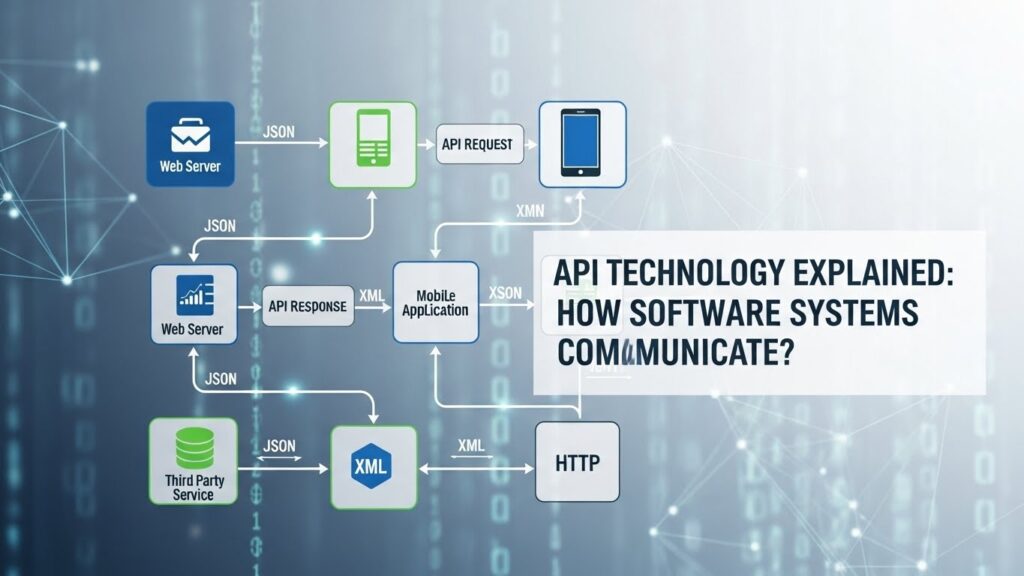
When API technology explained clearly, it becomes evident that APIs act as messengers. One system sends a request, the API processes it, and another system responds with the required data or action. This exchange happens without exposing internal logic or code. APIs are designed to be predictable and reusable. Developers don’t need to know how a system works internally; they only need to know how to interact with it through the API. This abstraction is what makes APIs so powerful and widely used.
Why APIs Are Essential for Software Communication?
Modern applications depend on multiple services working together. A single app may use authentication services, payment systems, analytics platforms, and cloud storage, all at the same time. APIs make this coordination possible.
Software communication through API technology explained enables modular design. Systems can evolve independently without breaking integrations. This flexibility is critical for scalability and long-term maintenance. APIs also support innovation. Developers can build new features by connecting existing services rather than creating everything from scratch. This reuse accelerates development and reduces complexity across digital ecosystems.
REST API Basics:
Among different API styles, REST (Representational State Transfer) is the most widely adopted. Understanding REST API basics is key to understanding modern API technology. REST APIs use standard web protocols to handle requests and responses. They follow a stateless approach, meaning each request contains all the information needed to process it. This simplicity makes REST APIs easy to use and scale.
REST APIs typically perform actions such as retrieving data, creating records, updating information, or deleting resources. Their predictable structure improves reliability and makes integration straightforward across platforms.
API Integration:
API integration refers to the process of linking different software systems so they can share data and functionality. This integration enables end-to-end workflows across applications.
For example, an e-commerce website integrates APIs for payments, shipping, and inventory management. Each system handles its own responsibility while APIs coordinate the interaction between them. Effective API technology explained integration improves efficiency, reduces manual work, and ensures data consistency. It is a foundational element of digital transformation and modern system design.
API Architecture:
API architecture defines how APIs are structured, secured, and managed. A well-designed API architecture ensures performance, reliability, and scalability. Key elements of API architecture include endpoints, data formats, authentication methods, and error handling. These elements determine how clients interact with the API and how safely data is exchanged.
Good API architecture also supports versioning. As systems evolve, APIs can be updated without disrupting existing integrations. This forward compatibility is essential for long-term system stability.
Web APIs:
Web APIs are APIs that operate over the web using standard internet protocols. They are the backbone of modern web and mobile applications.
Web APIs allow browsers, apps, and servers to communicate in real time. They enable features like real-time updates, third-party integrations, and cross-platform functionality. From social media platforms to cloud services, web APIs power nearly every digital experience today. Their ubiquity highlights why API technology explained is central to understanding modern computing.
Security and Reliability in API Technology
Security is a critical concern in API technology. APIs often handle sensitive data, making authentication and authorization essential components of API design.
Secure APIs control who can access data and what actions are allowed. They also protect systems from misuse, abuse, and data leaks. Reliability is equally important; APIs must handle errors gracefully and maintain uptime under high demand. Strong security and reliability practices ensure APIs remain trustworthy communication channels between systems.
Real-World Use Cases of API Technology
API technology is used across industries. Financial platforms rely on APIs for transactions and data exchange. Healthcare systems use APIs to connect patient records and diagnostic tools.
Technology companies use APIs to enable integrations, partner ecosystems, and developer platforms. Enterprises use APIs to connect internal systems and modernize legacy infrastructure. These real-world examples demonstrate how APIs are not optional—they are fundamental to how digital systems operate.
Challenges in API Technology
Despite their benefits, APIs introduce challenges. Managing multiple integrations increases complexity, and poorly designed APIs can become bottlenecks.
Documentation, version control, and monitoring are essential to prevent integration issues. Organizations must also ensure governance and consistency across API ecosystems. Understanding these challenges is part of mastering API technology explained in real-world environments.
The Future of API Technology
The future of API technology lies in greater automation, intelligence, and standardization. APIs are becoming smarter, supporting event-driven communication and real-time data exchange. As systems become more distributed, APIs will play an even larger role in enabling collaboration across platforms. Their evolution ensures continued flexibility and innovation in digital systems.
Conclusion:
Understanding API technology explained reveals why APIs are far more than technical connectors; they are strategic enablers of modern digital ecosystems. By standardizing how systems communicate, APIs allow organizations to build flexible, modular, and scalable software architectures that can evolve without constant rework. Through well-defined API architecture, efficient API integration, and widely adopted standards like REST API basics, APIs make software communication predictable and secure. They enable businesses to innovate faster by reusing services, integrating external platforms, and expanding functionality without rebuilding entire systems.
Looking ahead, API Technology Explained will only grow in importance. As systems become more distributed, real-time, and data-driven, web APIs will remain the glue that holds digital experiences together. Organizations that design, manage, and scale APIs effectively gain a long-term advantage, greater agility, faster innovation, and stronger ecosystem partnerships. In a world where connectivity defines success, APIs are not just tools; they are the foundation of modern software communication and the future of digital collaboration.
FAQs:
What is API technology explained in simple terms?
API technology allows different software systems to communicate and share data securely.
What are REST APIs?
REST APIs are web-based APIs that use standard protocols to exchange data.
Why is API integration important?
API integration enables systems to work together efficiently without manual intervention.
What are web APIs used for?
Web APIs power communication between browsers, apps, and servers across the internet.
Is API technology explained necessary for modern software?
Yes. APIs are essential for scalability, integration, and digital transformation.


