
Machine Learning Explained: How Systems Learn From Data
In today’s technology-driven world, systems are no longer limited to following fixed rules. Instead, they can learn, adapt, and improve based on Machine Learning Explained. This capability is powered by machine learning, one of the most influential fields in modern technology. From personalized recommendations to fraud detection and predictive analytics, machine learning has become a core driver of intelligent systems.
At its essence, machine learning allows computers to learn patterns from data rather than being explicitly programmed for every scenario. This shift has transformed how software is built and how decisions are made. Understanding machine learning explained basics helps explain why modern systems are becoming smarter, faster, and more autonomous. This article explains the machine learning explained process in a simple, structured way. You’ll learn how systems learn from data, explore key learning types such as supervised learning and unsupervised learning, understand common ML algorithms, and see real-world ML use cases that demonstrate its impact.
What Is Machine Learning?
Machine learning is a branch of artificial intelligence that focuses on building systems capable of learning from data. Instead of relying on predefined rules, machine learning models identify patterns, relationships, and trends within datasets and use them to make predictions or decisions.
The core idea behind machine Machine Learning Explained is -based improvement. A system is trained on data, evaluated on its performance, and then refined over time. The more relevant data it processes, the better its accuracy becomes. This learning process is what distinguishes machine learning from traditional software development. Machine learning systems rely on three essential components:
- Data, which provides examples and context
- Algorithms, which define how learning happens
- Models, which represent learned patterns
Together, these components allow machines to move beyond static logic and adapt to new information dynamically.
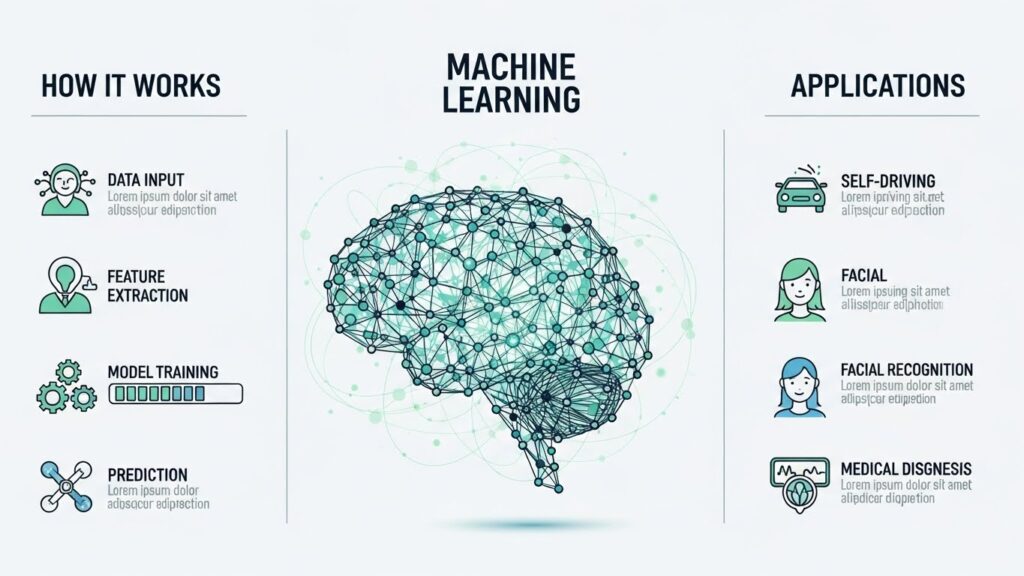
Machine Learning Basics:
Understanding Machine Learning Explained starts with recognizing how data is transformed into knowledge. The process begins with collecting data relevant to a specific problem, such as user behavior, transaction records, or sensor readings. Once collected, the data is cleaned and prepared. This step removes inconsistencies, fills gaps, and structures information so algorithms can process it effectively. High-quality data is critical, as machine learning models can only be as good as the data they learn from.
Next, an algorithm is applied to the data to create a model. The model identifies patterns and relationships that help it make predictions or classifications. After training, the model is tested using new data to evaluate accuracy. If performance is insufficient, the model is adjusted and retrained. This iterative cycle, train, test, and refine, is the foundation of how machine learning systems continuously improve.
Supervised Learning:
Supervised learning is the most widely used machine learning approach. In this method, systems learn from labeled data, where the correct output is already known. Each data point includes both the input and the expected result.
For example, a supervised learning model trained to detect spam emails learns from examples labeled as “spam” or “not spam.” Over time, it recognizes patterns that distinguish one category from another. Supervised learning is commonly used for:
- Classification tasks, such as image or text categorization
- Regression tasks, such as price prediction or demand forecasting
Because results are clearly defined, supervised learning is highly effective for structured problems where historical data is available.
Unsupervised Learning:
Unlike supervised learning, unsupervised learning works with unlabeled data. The system is not told what the correct answers are; instead, it explores the data to identify patterns, groupings, or relationships on its own. This approach is especially useful when dealing with large datasets where labeling is impractical. Unsupervised learning helps uncover insights that may not be obvious to human analysts.
Common applications include:
- Customer segmentation
- Anomaly detection
- Pattern discovery in large datasets
Unsupervised learning plays a vital role in exploratory analysis and supports a deeper understanding of machine learning basics.
ML Algorithms:
At the heart of machine learning are ML algorithms, mathematical methods that guide how systems learn from data. Different algorithms are suited to different tasks, depending on data type and problem complexity.
Some algorithms focus on classification, others on prediction, clustering, or optimization. While users don’t need to understand the mathematics behind them, knowing that algorithms determine how learning occurs is key to understanding machine learning. Choosing the right algorithm directly affects model accuracy, efficiency, and scalability. This is why algorithm selection is a critical step in any machine learning project.
Training, Testing, and Improving ML Models
Machine learning is not a one-time process. After training a model, developers evaluate its performance using test data that the model has never seen before. This ensures the system can generalize rather than memorize.
If performance is poor, adjustments are made, either by improving data quality, selecting different algorithms, or fine-tuning parameters. This refinement process continues until the model reaches acceptable accuracy. Ongoing monitoring is also essential. As real-world data changes, models may need retraining to stay relevant. This continuous improvement cycle is what makes machine learning systems adaptive and reliable over time.
ML Use Cases Across Industries
Real-world ML use cases demonstrate how machine learning drives innovation across sectors.
In business, machine learning supports recommendation systems, demand forecasting, and customer behavior analysis. In finance, it detects fraud and assesses credit risk. Healthcare uses machine learning to analyze medical images, predict outcomes, and personalize treatment plans. Technology platforms rely on machine learning for search optimization, content moderation, and personalization. Manufacturing uses it for predictive maintenance and quality control. These examples highlight how machine learning transforms raw data into actionable intelligence.
Challenges and Limitations of Machine Learning
Despite its power, machine learning has limitations. Models depend heavily on data quality, and biased data can lead to biased outcomes. Complex models may also lack transparency, making it difficult to explain decisions.
Another challenge is scalability. As datasets grow, systems require more computing resources. Addressing these challenges requires careful design, ethical considerations, and ongoing oversight. Understanding these limitations is part of mastering machine learning explained basics and using the technology responsibly.
The Future of Machine Learning
Machine learning continues to evolve toward more efficient, explainable, and autonomous systems. Future developments focus on reducing data dependency, improving interpretability, and integrating learning into everyday software seamlessly.
As machine learning becomes more accessible, it will move from specialized applications into standard digital infrastructure. This progression ensures that machine learning remains a foundational technology shaping innovation for years to come.
Conclusion:
Understanding machine learning explained gives the reason why modern systems are becoming smarter and more adaptive. By learning from data, machines can recognize patterns, make predictions, and improve performance without constant human intervention.
From supervised learning and unsupervised learning to powerful ML algorithms and real-world ML use cases, machine learning forms the backbone of intelligent technology. As data continues to grow, machine learning will remain essential for turning information into insight and action.
FAQs:
What is machine learning explained in simple terms?
Machine learning is a method that allows computers to learn from data and improve performance without explicit programming.
What are the main types of machine learning?
The main types are supervised learning, unsupervised learning, and reinforcement learning.
Why are ML algorithms important?
ML algorithms define how systems learn patterns and make predictions from data.
How is machine learning used today?
Machine learning is used in recommendations, fraud detection, healthcare analysis, and automation.
Is machine learning the same as AI?
Machine learning is a subset of artificial intelligence focused on learning from data.


