
Internet of Things (IoT): How Smart Devices Are Connected
IoT is one of the most important technologies shaping the modern digital Internet of Things world. From smart homes and wearable devices to industrial automation and connected cities, IoT is quietly transforming how devices communicate, collect data, and work together. What once required human input is now handled automatically through connected systems.
At its core, the Internet of Things refers to a network of smart devices that are connected to the Internet and can exchange data without constant human involvement. These devices use sensors, software, and connectivity to monitor environments, respond to commands, and make data-driven decisions. This form of connected technology is what enables everyday conveniences like smart thermostats, fitness trackers, and voice-controlled assistants. This article explains IoT clearly and practically. You’ll learn what the Internet of Things actually is, how smart devices communicate, and where IoT applications are already being used in daily life and business. We’ll also explore real IoT examples and look ahead to the IoT future to understand why this technology is considered a foundation of the next digital era.
What Is the Internet of Things?
To understand the Internet of Things IoT, it’s important to focus on the basic idea behind it rather than the technical jargon. The Internet of Things refers to a system where physical objects, such as appliances, sensors, vehicles, and wearable gadgets, are connected to the internet and can collect, send, and receive data automatically. Every IoT system is built on three core components: devices, connectivity, and data processing. The devices are the physical smart devices equipped with sensors that measure things like temperature, movement, location, or usage. Connectivity allows these devices to send data to other systems using Wi-Fi, mobile networks, Bluetooth, or other communication methods. Data processing then analyzes this information and triggers actions, insights, or alerts.
Another important concept is automation. IoT systems reduce the need for manual control by allowing devices to act based on predefined rules or real-time data. For example, a smart thermostat can adjust room temperature automatically based on occupancy and weather conditions. This level of automation is what makes connected technology efficient and scalable. IoT also relies heavily on real-time data. Unlike traditional systems that collect information occasionally, IoT devices continuously gather and transmit data. This constant flow enables faster decision-making, predictive maintenance, and smarter responses across many IoT applications.
How Smart Devices Communicate?
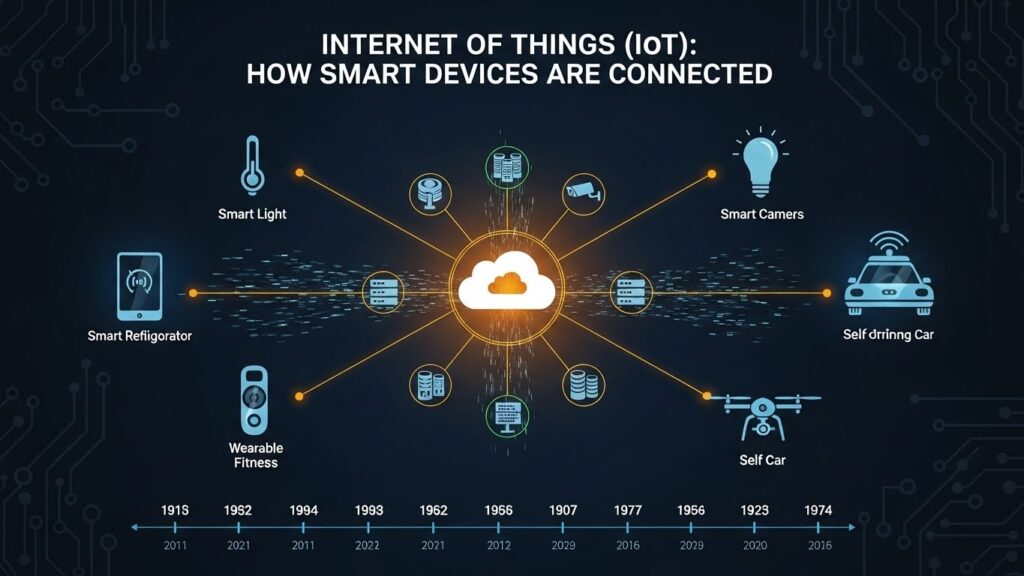
Communication is the foundation of the Internet of Things IoT. Without the ability to collect and transmit data, smart devices would simply be ordinary electronics. What makes them “smart” is how sensors, networks, and data systems work together in a continuous loop. It all starts with sensors. Sensors are embedded components that detect physical conditions such as temperature, motion, light, pressure, location, or humidity. In many smart devices, multiple sensors work together to create a detailed picture of the environment. For example, a fitness tracker uses motion and heart-rate sensors to monitor activity and health metrics in real time.
Once data is collected, it needs to be transmitted. This is where networks come into play. IoT devices use various communication methods depending on power needs, range, and use case. Common options include Wi-Fi for home devices, Bluetooth for short-range connections, mobile networks for wide-area coverage, and low-power networks designed specifically for IoT. These networks enable seamless connected technology, allowing devices to stay online and responsive. After transmission, data moves to processing systems, often hosted in the cloud. Here, the data is analyzed, stored, and compared against predefined rules or machine-learning models. Based on this analysis, actions can be triggered automatically, such as sending alerts, adjusting settings, or updating dashboards. This process is what turns raw sensor data into meaningful outcomes across different IoT applications.
Real-World IoT Examples:
The impact of the Internet of Things IoT is already visible across many parts of everyday life and industry. What makes IoT powerful is its flexibility; similar technologies can be adapted to homes, cities, businesses, and even personal health. One of the most familiar IoT examples is the smart home. Devices such as smart thermostats, lighting systems, security cameras, and voice assistants work together to automate daily routines. These smart devices respond to user behavior, time schedules, and environmental data to improve comfort, energy efficiency, and safety.
In healthcare, IoT plays a critical role in remote monitoring and patient care. Wearable devices track heart rate, physical activity, and sleep patterns, sending real-time data to healthcare providers. This allows early detection of health issues and reduces the need for constant in-person visits, one of the most impactful iot applications in modern medicine. Manufacturing and industry also rely heavily on IoT. Sensors attached to machines monitor performance, detect faults, and predict maintenance needs before failures occur. This approach, often called predictive maintenance, reduces downtime and improves productivity through reliable connected technology. In transportation and smart cities, IoT helps manage traffic flow, monitor public infrastructure, and optimize energy usage. Smart traffic lights adjust based on congestion, while connected parking systems guide drivers to available spaces. These systems improve efficiency while reducing environmental impact.
Benefits and Challenges
The Internet of Things IoT delivers powerful advantages, but it also introduces new challenges that must be managed carefully. Understanding both sides helps explain why IoT adoption continues to grow, and why responsible implementation matters.
Key Benefits of IoT
One of the biggest benefits of IoT is automation and efficiency. By allowing smart devices to collect data and act automatically, IoT reduces manual effort and improves accuracy. Systems can respond in real time, whether it’s adjusting temperature, rerouting traffic, or detecting equipment issues before failures occur. IoT also enables better decision-making through data. Continuous data collection provides insights that were previously impossible or expensive to obtain. Across many IoT applications, this data helps organizations optimize operations, reduce costs, and improve user experiences.
Another major advantage is remote monitoring and control. Users can manage devices from anywhere using connected platforms. This flexibility is a core strength of connected technology, allowing businesses to scale operations and individuals to control environments without being physically present. Finally, IoT supports innovation across industries. From healthcare and agriculture to transportation and smart cities, IoT creates new services and business models that rely on real-time connectivity and intelligent systems.
Key Challenges of IoT
Despite its benefits, IoT also introduces security and privacy risks. Many IoT devices collect sensitive data and remain connected continuously, making them potential targets for cyber attacks. Poorly secured devices can compromise entire networks, raising concerns about data protection and trust. Another challenge is data management. IoT systems generate massive volumes of data, which must be stored, processed, and analyzed efficiently. Without proper infrastructure, this data can become overwhelming rather than useful.
Interoperability and standardization are also ongoing issues. Different manufacturers often use different protocols, making it difficult for devices to work seamlessly together. This fragmentation can limit scalability and increase complexity. Lastly, cost and complexity can be barriers, especially for large-scale deployments. While individual devices may be affordable, designing, maintaining, and securing an IoT ecosystem requires careful planning and expertise.
Conclusion:
The Internet of Things IoT is transforming how technology interacts with the physical world. By connecting smart devices through networks and data systems, IoT enables automation, real-time insights, and smarter decision-making across homes, businesses, and cities. What once required constant human input is now handled seamlessly through connected technology.
From everyday conveniences to large-scale industrial systems, IoT has already proven its value through practical IoT examples and high-impact IoT applications. At the same time, challenges such as security, privacy, and interoperability highlight the need for thoughtful design and responsible use. As technology continues to evolve, the IoT future will depend on balancing innovation with trust, safety, and scalability. Understanding IoT today provides a strong foundation for navigating tomorrow’s digital landscape, where connectivity, data, and intelligent systems work together to improve efficiency and quality of life.
FAQs
1. What is the IoT in simple terms?
The Internet of Things refers to physical devices connected to the internet that collect, share, and act on data automatically.
2. How do smart devices work in IoT systems?
Smart devices use sensors to collect data, networks to transmit it, and software to analyze and trigger actions.
3. What are common IoT examples in daily life?
Examples include smart home devices, fitness trackers, security systems, smart appliances, and connected vehicles.
4. What industries use IoT applications the most?
Healthcare, manufacturing, transportation, agriculture, retail, and smart cities widely use IoT applications.
5. Is the Internet of Things secure?
IoT can be secure if devices are properly configured, updated, and protected with strong security practices.


